
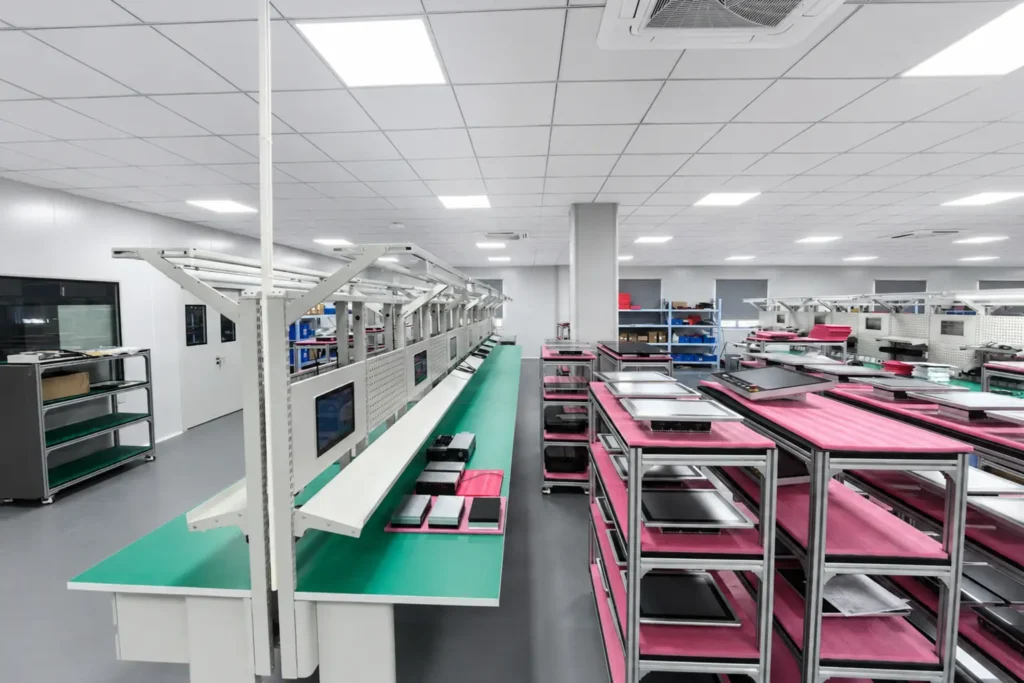
AUTOMATED PRODUCTION LINE
A 21.5-inch control console matched to integration constraints.
The published brief records a 21.5-inch capacitive display, at least 16 GB memory and continuous control-console operation.
Around a third of what leaves our floor is not a catalogue product. Because tooling, board design, assembly and testing are all in-house, a changed enclosure depth or an extra isolated serial port is a production decision we can schedule — not a supplier request we have to pass on.
Figures are typical for panel PC projects and are confirmed in writing with every quotation.
Most projects touch four or three of these. Anything not listed here is still worth asking about — the answer is usually a schedule and a cost rather than a refusal.

New sheet metal or die-cast housing, changed depth, bezel colour, cut-out pattern and cable entry positions.
Panel size, brightness, aspect ratio and touch technology chosen against the actual operating environment.
Port count, port position and isolation specified to match the machine rather than a generic layout.
Brackets and mounting patterns designed around the position the unit actually occupies.
Input range, protection and temperature testing matched to the cabinet and the site supply.
The unit arrives ready to install with your identity and your software already on it.
You never wait on an unspecified “development” phase. Every stage ends in a document, a sample or a report.
You describe the application, environment, interfaces and volumes. We ask the questions that usually surface later — glove type, cleaning regime, cable runs, cabinet temperature.
A proposed configuration with the reasoning behind each choice, a unit price, any tooling cost and a realistic schedule.
2D drawings and a 3D STEP model for your mechanical team to check against the machine before anything is cut.
A sample built to the approved drawing and production tooling wherever possible, so the first unit is what you will receive.
Environmental, vibration, EMC pre-scan and burn-in testing in our laboratory, run in parallel with your own field trial.
The configuration is frozen under a part number and revision, with change notification before any component substitution.
You do not need all of this to start a conversation — but the more of it we have, the fewer rounds it takes to reach a firm price.
Customer names withheld where confidentiality applies; drawings and reports for each of these are available on request under NDA.
Send an application description or a drawing. An engineer reviews every enquiry and replies with a configuration, a lead time and a price within one working day.