
Opens in a new tab
Static design prototype · verified family-level data only · per-variant specifications require final datasheet review
Custom services

Panel PCs built to your drawing, not adapted to ours.

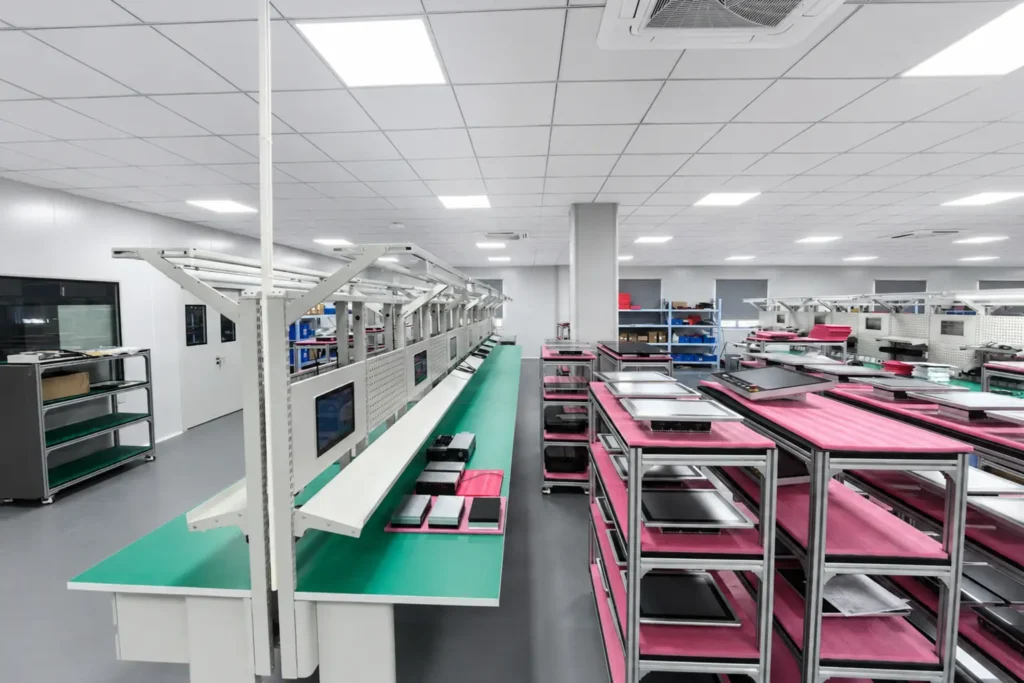
Around a third of what leaves our floor is not a catalogue product. Because tooling, board design, assembly and testing are all in-house, a changed enclosure depth or an extra isolated serial port is a production decision we can schedule — not a supplier request we have to pass on.

Typical engagement

First response
Drawing & quotation
Prototype sample
Minimum order
Tooling required from

Figures are typical for panel PC projects and are confirmed in writing with every quotation.

Scope

Six areas customers most often change.

Most projects touch four or three of these. Anything not listed here is still worth asking about — the answer is usually a schedule and a cost rather than a refusal.

Enclosure and mechanics icon

Enclosure & mechanics

New sheet metal or die-cast housing, changed depth, bezel colour, cut-out pattern and cable entry positions.

  • Aluminium, steel and 304/316 stainless bodies
  • Front IP65 to IP69K sealing options
  • Custom cut-outs for keypads, readers and E-stops

Display & touch

Panel size, brightness, aspect ratio and touch technology chosen against the actual operating environment.

  • 7–21.5-inch panels, 300 to 1500 nits
  • Resistive, projected capacitive and glove-tuned firmware
  • Optical bonding, anti-glare and anti-fingerprint treatments

I/O & expansion

Port count, port position and isolation specified to match the machine rather than a generic layout.

  • Additional RS-232/422/485, isolated or non-isolated
  • Extra LAN, CAN, USB, DIO and audio
  • Mini-PCIe, M.2 and PCI/PCIe expansion

Mounting & installation

Brackets and mounting patterns designed around the position the unit actually occupies.

  • Panel, VESA, arm, pole and DIN-rail mounting
  • Recessed brackets matching an existing cut-out
  • Vibration-rated fixing for mobile machinery

Power & environment

Input range, protection and temperature testing matched to the cabinet and the site supply.

  • 9–36 V DC and 100–240 V AC input options
  • Reverse-polarity, surge and ignition-controlled circuits
  • Extended-temperature builds from −20 to 60 °C

Branding & software

The unit arrives ready to install with your identity and your software already on it.

  • Silk-screened logo, custom labels and packaging
  • Boot logo, BIOS shortcuts and locked configuration
  • Windows IoT or Linux images cloned to every unit
Process

Six stages, each with something you can review.

You never wait on an unspecified “development” phase. Every stage ends in a document, a sample or a report.

01

Requirement review

You describe the application, environment, interfaces and volumes. We ask the questions that usually surface later — glove type, cleaning regime, cable runs, cabinet temperature.

Output: requirement summary
02

Concept & quotation

A proposed configuration with the reasoning behind each choice, a unit price, any tooling cost and a realistic schedule.

Output: quotation + concept sketch
03

Drawing approval

2D drawings and a 3D STEP model for your mechanical team to check against the machine before anything is cut.

Output: 2D drawing + STEP file
04

Prototype build

A sample built to the approved drawing and production tooling wherever possible, so the first unit is what you will receive.

Output: sample unit + BOM
05

Validation

Environmental, vibration, EMC pre-scan and burn-in testing in our laboratory, run in parallel with your own field trial.

Output: test reports
06

Series production

The configuration is frozen under a part number and revision, with change notification before any component substitution.

Output: frozen part number + PO policy
Before you enquire

What makes a fast, accurate quotation possible.

You do not need all of this to start a conversation — but the more of it we have, the fewer rounds it takes to reach a firm price.

Send if you have it

  • A drawing or photograph of the cut-out or mounting position
  • Screen size, resolution and required brightness
  • The list of ports the machine needs, and which must be isolated
  • Operating temperature and humidity range at the installed position
  • Cleaning method and any chemicals used on the front surface
  • Annual volume and the date first units are needed
Contact Form
Recent work

Requirements translated into working configurations.

Customer names withheld where confidentiality applies; drawings and reports for each of these are available on request under NDA.

Questions

What customers ask before starting.

Is there a charge for the drawing and the quotation?
No. Requirement review, the proposed configuration, the quotation and the 2D drawing are provided without charge. Costs begin if prototype build, tooling costs or a new engineering phase is approved.
Who owns the design of a custom product?
Ownership depends on the engagement level and is agreed before development. Customer-funded exclusive designs can be protected by contract.
Can you keep the same configuration available for years?
Yes. Approved configurations receive a controlled part number and revision. We notify you before component substitutions and can plan last-time buys when needed.
Will you sign an NDA before we send drawings?
Yes. We can review and sign a mutual NDA before you share drawings, software details or other confidential project information.
Do you handle certification for the end market?
We can provide existing reports where applicable and support CE, FCC, UL and market-specific certification as a quoted part of the project.

Tell us what your panel PC needs to do.

Send an application description or a drawing. An engineer reviews every enquiry and replies with a configuration, a lead time and a price within one working day.